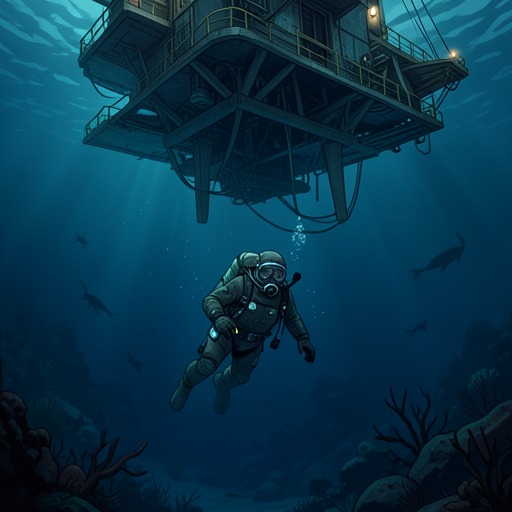
The Deep Submergence Combat Corps harbor-clearing campaign
World War ZThe Deep Submergence Combat Corps harbor-clearing campaign was one of the war’s most hazardous logistical and military operations: it sought not merely to secure beaches, but to make drowned harbors usable again for deepwater shipping. Its importance lay in restoring the maritime infrastructure needed to move resources, refugees, fuel, and materiel through a country whose industrial survival depended on logistics as much as on weapons.
Origins and Strategic Purpose
The Deep Submergence Combat Corps began when civilian oil workers refused to return to their jobs unless their escorts were better armed. Divers working in dry suits, near darkness, and extreme cold or heat could be attacked without warning by undead emerging from the water. Workers might feel hands or teeth, call for help, and then be pulled beneath the surface, leaving only body parts or a severed lifeline. The Corps was therefore first formed to protect rig divers and keep oil production flowing.
Its mission later expanded to beachhead sanitation and, in the final stages of the war, harbor clearing. Beachhead sanitation meant helping conventional marines come ashore by establishing a semicircular underwater perimeter around a landing site. The net had to be deep enough for ships to pass over while remaining high enough to keep the undead from crossing it. Sonar could draw large numbers of undead toward the transmitting vessel, but commanders accepted that danger because they had few better alternatives. The first amphibious landings using this method proved comparatively easy, and after three operations mesh divers generally resumed the work.
Harbor clearing had a different strategic scale. The objective was no longer simply to protect an initial landing area, but to reopen ports for deepwater shipping. That made the campaign part of the larger struggle over production and supply. The living controlled only limited territory, and American war production depended heavily on what could be harvested within the western states. Refugees crowded merchant ships, fuel shortages had left much of the navy dry-docked, and the undead controlled most of the world’s landmass. Under those conditions, a harbor was not just a coastal site; it was a potential artery for national reconstruction.
Forces and Methods
The campaign was a combined operation involving mesh divers, ADS units, and civilian volunteers equipped with little more than scuba gear and spear guns. The mixture reflected both necessity and the unusual physical environment. No single military specialty could handle wrecked vessels, underwater debris, undead concentrations, damaged structures, and the demands of restoring a functioning port. Civilian participation also showed how thoroughly the war had absorbed the population’s skills and risks.
The campaign operated alongside a broader wartime doctrine that treated every weapon and mission according to its resource-to-kill ratio. The United States had to manufacture more than ammunition: it needed raw materials, transport, maintenance, and systems capable of surviving repeated use. The air force’s Continental Airlift illustrated the same principle on land, coordinating supplies for isolated Red and Blue Zones and favoring self-sustaining drops such as tools and spare parts over deliveries that created permanent dependency. Harbor clearing served the same economic logic at sea: reopening infrastructure could produce continuing capacity rather than a single tactical success.
The equipment used by the wider reconstituted army reflected this emphasis on reliability and mass production. The Standard Infantry Rifle was valued for accuracy, resistance to mud, sand, and saltwater, and a conversion system that allowed it to serve as a sniper rifle, standard rifle, or carbine. Its folding spike could serve as an emergency close-combat weapon. Its standard Cherry PIE ammunition shattered inside an undead skull and destroyed the brain without spreading infected tissue, eliminating the need for wasteful burning and allowing whole bodies to be buried after duty. These principles of durable, economical equipment also shaped the specialized work of the Corps.
Major Harbor Operations
The Corps helped clear Charleston, Norfolk, Boston, and the Hero City. The last was described as the greatest of the underwater nightmares. A drowned city combined the scale of an urban battlefield with the concealment and disorientation of deep water: sunken ships, cars, aircraft, and miscellaneous wreckage filled the harbor, while cargo dumped overboard during the evacuation created additional layers of obstruction. Couches, toaster ovens, huge piles of clothing, smashed air conditioners, and crushed plasma televisions turned familiar household objects into an alien landscape.
The operators’ imagination became part of the danger. The debris could resemble bone, and the divers repeatedly imagined undead concealed behind washing machines and dryers or climbing across heaps of wreckage. Sometimes the fear was only imagined; sometimes it was not. The campaign’s horror came not solely from visible attacks, but from the inability to distinguish ordinary obstruction from a waiting enemy. The underwater setting made familiar consumer goods strange and threatening, forcing divers to experience their own discarded civilization as camouflage for the dead.
Sunken ships required especially painstaking work. Refugee vessels and support ships had gone down inside harbor limits, and they could not simply be bypassed if the port was to be made safe. One major example was the Frank Cable, a submarine tender converted into a refugee ship, which sank at the harbor mouth. Before it could be raised, operators had to search it compartment by compartment. Hatches were often blocked by debris, requiring divers to cut through doors, decks, or bulkheads. Damage and corrosion weakened the structure, making the ship itself an unstable hazard.
During one sweep of the Frank Cable, an operator was cutting through a bulkhead above the engine room when the deck collapsed. Hundreds of undead were waiting below. The diver was engulfed in legs, arms, and bodies before having time to swim or think. The incident condenses the campaign’s defining reversal: a task organized as controlled engineering and sanitation could become immediate physical annihilation, with the supposedly secure structure turning into a trap.
Consequences and Psychological Cost
The campaign reopened access to important harbors, but its success was purchased through sustained exposure to conditions that conventional military doctrine had not prepared soldiers to understand. The larger war confronted the living with approximately two hundred million undead, a force that did not need to be bred, fed, or led. The old book of war therefore became useless, and new procedures had to be written from the ground up. Harbor clearing was one of the clearest expressions of that transformation because it required combatants to fight in a space where terrain, visibility, movement, and even the direction of attack were radically altered.
The ADS suit offered protection but created its own vulnerability through complete tactile blackout. Because the suit was hard, the operator could not feel the outside world, even when an undead creature had its hands on the armor. Unless the creature actively pulled or flipped the diver, the operator might not know it was present until its face pressed against the helmet. In the darkness of the Troll operation, helmet lights intensified the problem by producing glare broken only by sudden undead hands or faces. The suit protected the body while severing the ordinary sense of touch that might have revealed danger.
The underwater campaign also exposed the limits of psychological preparation. Across the new army, long-term Z-shock caused trained personnel to collapse, commit suicide, or turn weapons on comrades. The Corps’ operators faced an especially concentrated version of that strain: darkness, cold, restricted movement, unreliable structures, and the possibility that an unseen body was waiting on the other side of every obstruction. The memory of the Frank Cable engine room remained so vivid that it was imagined as a recurring nightmare, even when the witness tried to deny having nightmares at all.
Historical Significance
The Deep Submergence Combat Corps harbor-clearing campaign linked battlefield courage to national recovery. Its divers did not merely kill undead; they restored access to ports, protected the flow of oil, and made it possible for ships and supplies to move through infrastructure that had become unusable. In a war where victory depended on resources, production, transport, and repair, clearing a harbor could matter as much as winning a visible engagement on land.
The campaign also demonstrates how the living adapted by combining military force, civilian expertise, and improvised technology. Mesh divers, armored units, oil workers, and volunteers with spear guns occupied the same operational field. Their work replaced assumptions about clean fronts and recognizable terrain with a method based on endurance, inspection, cutting, containment, and repeated risk. The final image of a seafloor resembling a white desert, marked by broken coral and crossed by the living dead, gives the campaign its lasting emblem: the sea itself had become a battlefield, and reclaiming the future required descending into it.